


We often think relationships are shaped by big talks, major conflicts, or rare turning points. In daily life, though, most relational patterns are built in small moments. A delayed reply. A softened tone. A habit of interrupting. A quiet act of support. These details may look minor, yet they form the structure of how we live with others.
Mapping relational dynamics means noticing how people affect each other through repeated patterns of emotion, behavior, and response.
We see this clearly when we step back from the content of a relationship and look at its movement. Who speaks first? Who withdraws? Who repairs tension? Who carries emotional weight? When we ask these questions, we stop reacting blindly and start seeing structure.
One morning, we may leave home feeling calm, then return from a short conversation oddly tense. Nothing dramatic happened. Still, something shifted. That is how relational dynamics work. They are not always loud. They are often subtle, repeated, and deeply shaping.
What are we really mapping?
When we map relational dynamics, we are not judging people. We are observing patterns. A pattern is any response that shows up often enough to influence the quality of a bond. It may involve words, silence, body language, timing, expectations, or emotional roles.
In our experience, it helps to map five basic elements:
- Frequency of contact
- Emotional tone after interactions
- Typical roles each person takes
- Triggers that create tension or closeness
- Ways conflict begins, grows, or settles
This kind of observation gives us a clearer picture of the relationship as it is, not as we wish it were.
Patterns speak before words do.
Daily life offers a strong field for this work because relationships are not abstract. They happen at breakfast, in meetings, on the phone, in family routines, and during brief exchanges that repeat over time. In fact, research on daily social interactions found that two-person interactions are the most common social setting in everyday life, making up about 52.6% of observed situations. That matters. It means the pair bond, whether at home, work, or friendship, is where many of our strongest patterns are formed.
How to start seeing patterns
Most people begin by focusing on events. We think this person upset us, that person supported us, or one talk changed everything. Events matter, but patterns explain more. To map them well, we need a short period of honest observation.
A simple way to begin is to choose three relationships from different areas of life. For example:
- One family relationship
- One friendship
- One work or study relationship
Then observe each one for a week. Do not try to fix anything at first. Just record what happens. We suggest noting:
- What happened
- How we felt before the interaction
- How we felt after it
- What role we took
- What the other person seemed to take
The goal is not to collect drama, but to identify repetition.
Sometimes the result surprises us. A relationship we call “easy” may leave us drained three times out of five. A person we see as “difficult” may only become defensive after a specific kind of pressure. Once seen, these patterns lose some of their power to confuse us.
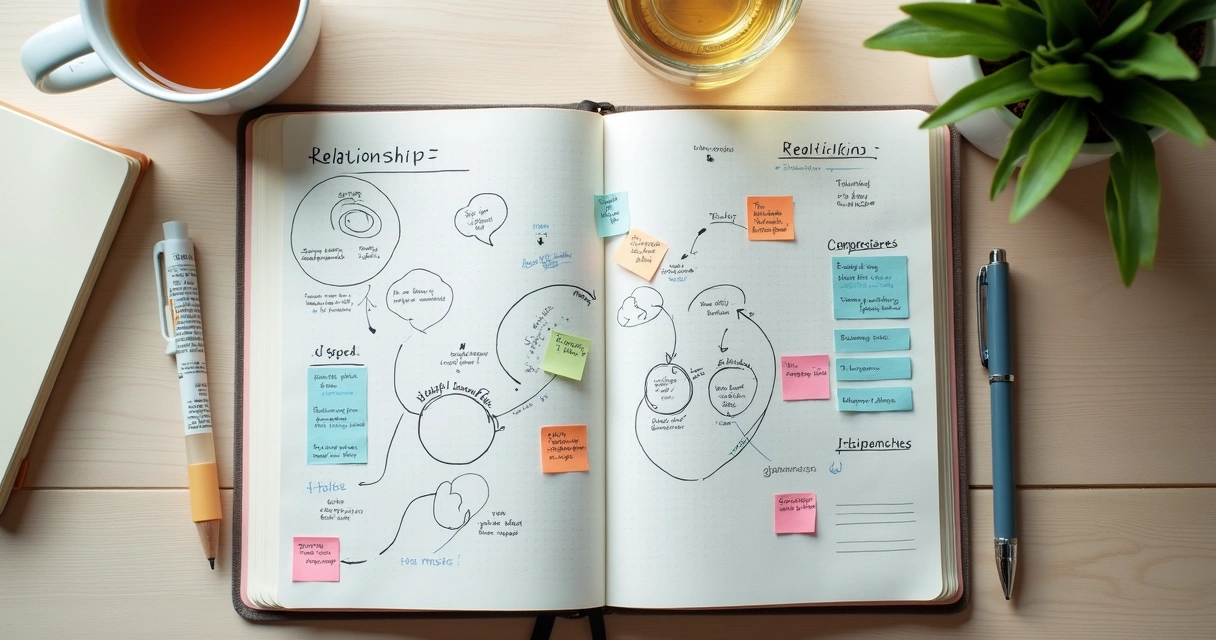
Roles that repeat in daily relationships
Many relationships become organized around roles. We may become the one who calms, explains, avoids, chases, pleases, or controls. The other person may take a matching role without either side planning it.
Some common repeating roles include:
- The pursuer, who seeks contact and resolution fast
- The withdrawer, who pulls back under pressure
- The fixer, who rushes to solve feelings
- The carrier, who holds more than their fair share
- The critic, who protects themselves through correction
These roles are not fixed identities. They are positions we enter under certain conditions. That is a hopeful point, because what is learned can also be changed.
We have seen this in ordinary scenes. A parent asks a simple question. A grown child hears control instead of care. The answer comes sharp. The parent then becomes hurt and moralizing. In five seconds, old roles return. The words are new. The pattern is not.
When we name a repeated role, we create room for a different response.
What strengthens or weakens a bond?
Not every tense pattern means a relationship is failing. Some bonds are strong enough to hold friction. What matters is whether the relationship can recover, adjust, and regain clarity.
We think four signals are useful when reading this:
- Whether both sides can express discomfort
- Whether repair happens after strain
- Whether one person is always adapting
- Whether contact brings steadiness or confusion
These signs matter because stable relationships are not only warm. They are also readable. We know where we stand. We can speak without excessive fear. We can disagree without losing our center.
This is one reason relationship mapping has value beyond private reflection. Broader social data also suggests that connection quality has a long arc in human well-being. An OECD report on social connections and relationship satisfaction showed that average satisfaction with personal relationships moved only slightly across the years studied, while dissatisfaction stayed fairly stable. That tells us something simple. Relationships do not improve by default. They need awareness, honest adjustment, and steadier forms of presence.
Building a practical map
A useful map does not need complex tools. It needs consistency. We can create a simple page for each relationship and review it at the end of the week.
Each page can include these headings:
- Main setting of contact
- Usual emotional climate
- Recurring trigger points
- My default reaction
- Their default reaction
- How repair happens, if it happens
After a week or two, we can look for links between them. Do we become silent with one person and reactive with another? Do we over-explain in relationships where we expect misreading? Do we shrink around people who dismiss our limits?

Good mapping also includes context. A strained month at work may affect how we show up at home. Fatigue can sharpen conflict. Shame can make neutral feedback feel harsh. If we leave out context, we may confuse a temporary state with a lasting pattern.
Conclusion
Relational dynamics shape daily life quietly, then deeply. When we map them, we begin to see the loops that keep bonds stable, tense, nourishing, or draining. That clarity helps us act with more honesty and less impulse.
A clear relational map helps us move from reaction to conscious choice.
We do not need perfect insight to begin. We only need attention, repeated observation, and the willingness to see what is there. Over time, this work can help us speak more cleanly, set better limits, and recognize where mutual care is truly present.
What we can see, we can reshape.
Frequently asked questions
What is relational dynamics mapping?
Relational dynamics mapping is the process of tracking repeated patterns in how people relate to each other. It includes emotional tone, communication habits, roles, triggers, and ways of handling tension. The aim is to understand how a relationship works in real life.
How do I map daily relationships?
We can map daily relationships by observing a few key interactions over several days and writing down what happened, how we felt, how the other person responded, and what pattern repeated. A notebook, journal, or simple chart is enough if we use it with consistency.
Why is mapping relationships important?
Mapping relationships matters because it helps us notice patterns that may be hidden during emotional moments. It can show where communication breaks down, where roles are rigid, and where repair is possible. This gives us a better base for change.
What tools help map relational dynamics?
Helpful tools include journaling, reflection prompts, mood tracking, weekly review pages, and simple diagrams with names, roles, and arrows showing interaction patterns. The best tool is the one we can keep using without making the process too heavy.
Can mapping improve my relationships?
Yes, mapping can improve relationships because it builds awareness. When we see repeated loops clearly, we can change how we respond, communicate with more precision, and set limits where needed. It does not change the other person by force, but it can change the quality of our participation.